Drug
Pipelines, patents, and prices
- Drug
- PatentBeta
- Drug PriceBeta
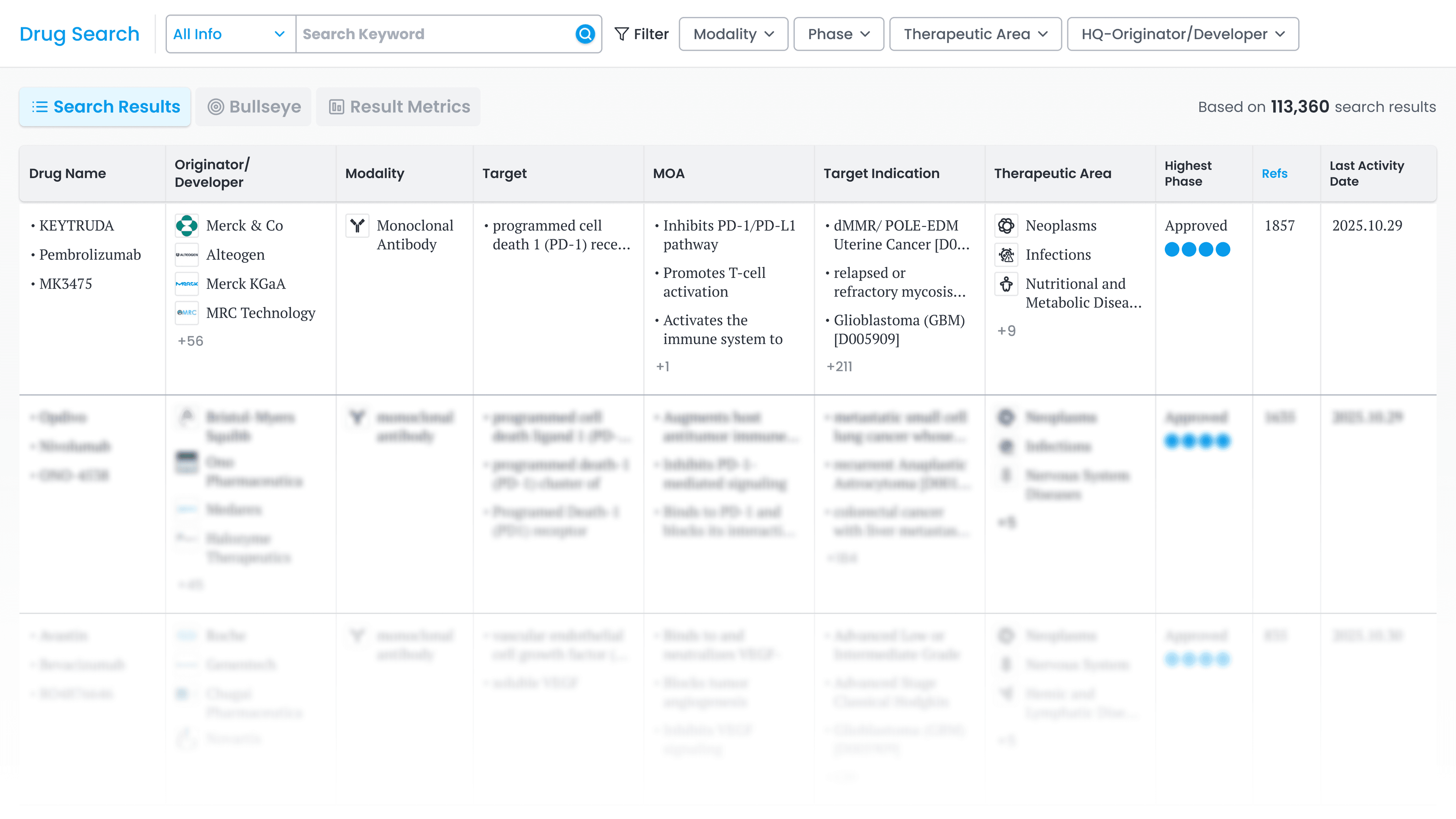
Drug pipelines, deals with original contracts, clinical, regulatory, patents, drug pricing, funding, companies and 14M+ publications in one platform, with an agent that runs the research for you. Every module included, at about 1/10 the price of legacy suites.
Trusted by business development, strategy and investment teams at 80+ companies in 18 countries












































Logos are shown with each company's permission. Global pharma, biotechs, consulting firms, investors and research institutes. References shared on request.
Type a target, indication or modality. The counts below are from live demos run in October 2026; the database grows daily, so your trial will show more.
In a recent meeting, a web search found 30 to 40 HPK1 programs in half an hour. Drug Search returned all 146 at once. That is the difference between a search engine and a structured database.
Which pipeline is worth the most, how the competitive landscape is moving, which partner to meet, what your technology is worth and how to structure the deal. These calls decide whether a drug reaches patients as much as the science does. R&D has always had rigorous data infrastructure. The teams making the business calls, BD, research strategy, consulting and investment, have worked with fragments. We built the platform that closes that gap.
Which asset to push, who to partner with, what the technology is worth and how to structure the contract. Every one of those calls depends on knowing the competitive and deal landscape, not just the science.
Every BD and strategy decision is ultimately a data decision. Teams without data negotiate against teams that have it. The question was how to get it without a big-pharma budget.
Established databases sell each module separately, often at tens to hundreds of thousands of dollars a year. Most biotechs, consultancies and research institutes simply go without. That is the gap we built for.
Everything shown here is yours to use in the free trial.
Try the demo below. Click the highlighted area to move to the next step.
Every competitor for a target in one table: developers, modality, MOA, indications and phase. Switch to the Bullseye view to see the same set as a chart by phase. Report-ready competitive analysis in minutes, from 360K+ drug profiles.
Try it on your pipelineBio Agent sits on a structured, real-time pharma and biotech database: 360-degree coverage from drugs and deals to patents, pricing, funding and publications, with statistics and prediction on top. Give it a research task too long and complex for general-purpose assistants, and it plans the work, runs across multiple data modules and analysis and prediction tools, and writes the report with every line cited.
Live · included in every subscription and trialBuild a competitive landscape on oral GLP-1 agonists in obesity, ranked by clinical readouts.
Every instruction becomes a visible research plan you can edit before anything runs.
Pipelines, trials, patents, prices, deals, companies and papers, queried in sequence and in parallel, each step feeding the next.
A written report where every claim links to the record it came from, ready for a deck or a term sheet.
Complex, week-long research becomes a task you hand off. One subscriber covers the work of two or more analysts. And because the agent holds the data, it does what general-purpose agents on Claude or GPT cannot: full-coverage, multi-step queries over structured biopharma data.
Every database, one agent. 13 sources, already wired in on the subscription you have.
Pipelines, patents, and prices
Deals, funding, companies, and papers
Trials and results
Guidelines, labels, CRLs, and expedited programs
Built from 100M+ source documents across 15+ countries, refreshed up to six times a day by thousands of automated agents. Every data point links to its original source.
Our own data silos cover the long tail and the blocked content that general AI tools cannot reach. Tens of thousands of records are added daily, millions more refreshed.
Coming next: proprietary datasets no public source holds. KOL interviews, drug revenue and patient counts, and prescription and sales data acquired through hospital, wholesale and pharmacy channels.
I was spending more time than I expected searching reference deals. The feature that provides the original contracts for reference deals is especially helpful.
When investing in early-stage biotech with limited information, referencing trends in modality, target and indication, along with Big Pharma's latest focus, makes decision-making easier and more effective.
We realized how many important trends closely related to our pipeline we had been missing. It's amazing that we no longer have to search for them manually.
We remain very impressed by the possibilities and ease of use of the Bio-Research.AI offering.
I was impressed by the demo. Scouting for out-licensing, financial terms and the competitive landscape would all be useful.
Our legacy database adds cost every time you add an element. Everything included, at this price, is a different proposition.
We always thought database subscriptions were money down the drain. This is the first one where the money did not feel wasted.
Incredibly affordable. I want to recommend this to people I know.
We looked at several databases and gave up because they were far too expensive for how much we would use them. This looks very good.
At a big pharma we paid hundreds of thousands of euros for a legacy database; at a mid-size pharma, tens of thousands. At this price it is a different conversation.
Intuitive, affordable, and a lot of data.
Excellent. Our CSO is going to love this.
The features keep getting better every time we look. It is actually fun to use.
Remarkably comprehensive. Twelve hundred stem-cell pipelines in one search.
The interface is clearly better than the legacy database we use today.
Let me dive into this sea of knowledge.
Every year now sets a new record for capital moving into and between pharma and biotech companies. More capital means more deals, more companies and more pipelines, and AI agents keep cutting the team size a biotech needs, so the number of companies multiplies faster than the number of people reading the market. Figures from our own Deal and Funding modules.
Source: Bio-Research.AI Deal Search and Funding Search, annual value view. 2026 is year to date (as of Nov 12, 2026); the hatched bars are still growing.
Incumbent databases run 1,000 to 5,000 human curators and sell each module separately. Our cost base is different by design, so the price is different by design, and it stays that way.
/year, for the scope a BD team actually uses
/year, first account · +$1,200 per additional account
$65,000 is what a legacy suite charges for the five or six modules a BD team actually works with, with team access. One module for one seat costs less, and that is the number a legacy sales rep will put in front of you. Compare the scope your team needs and the gap is ten times. Add accounts and it widens, because each additional account here is $1,200 a year.
That is why 80% of our subscribers are biotechs, consultancies, investors and research groups that could not justify a legacy suite, and the rest are pharma teams that no longer want to.
The collection, cross-validation and structuring that incumbents staff with 1,000 to 5,000 people runs here as 2,000+ AI processing logics, around the clock, operated by a team of 22. The database updates up to six times a day without a headcount to match.
The engineers who build and run the platform are in Korea, where senior engineering talent costs a quarter to a fifth of the US or UK at the same standard. Combined with the automation above, this is a permanent feature of our cost base, not a launch discount: the same global intelligence, at the same quality, will always cost less to produce here.
A database whose revenue forecast is built on five-figure module prices cannot cut them without cutting its own valuation. Automating their curation does not change that math. We never had that problem.
We launched in 2025 at about $2,500 a year and have shipped new modules every quarter since; the list price has moved with them to $7,200 today and will keep moving. Subscribers keep the price they signed at, with renewals moving only with inflation. The earlier you decide, the lower your price for as long as you stay. See what shipped, quarter by quarter
One subscription covers what other providers sell as five or more separate modules. The list price rises as data and features ship; the price you sign at is the price you keep. Prices exclude VAT.
Company-wide access for BD, strategy, R&D planning, IP and clinical teams.
First account included · +$650 per additional account
Top up once, spend credits only when you search. No annual seat, no contract.
12,000 credits · valid for 6 months · same platform, same data and same agent as annual subscribers
For early-stage biotechs, academic and research institutes, and teams of five or more.
Multi-seat bundles · regional pricing · parallel evaluation offers for teams on a legacy contract
Every plan starts with the same 1-week free trial: full platform, every module, no card required. Full plan details
Not every team needs every dataset, every feature, all year round. Until now, an annual seat was the only shape pharma intelligence came in. It is not anymore.
Same platform, same data, same Bio Agent as annual subscribers. No seat, no contract, no year-long commitment.
Most BD teams we meet are locked into a multi-year contract with a legacy provider and plan to look at alternatives when it ends. You do not have to wait.
Two or three accounts for the months left on your current agreement, prorated from the annual price. Your team compares both systems on real projects, not on a sales demo.
If the whole team moves after the evaluation, what you paid during it is credited against the first year of the team subscription.
Research institutes, tech transfer offices and consortia decide slowly. We extend trials to two to four weeks and provide a deck and reference calls for internal approval.
| What you compare | Legacy suite | Bio-Research.AI |
|---|---|---|
| Modules | Drugs, deals, clinical, regulatory, companies sold and priced separately | All modules in one subscription, including patents, drug pricing and publications |
| Annual price, comparable scope | Around $65,000 and up; each added element raises the price | $7,200 for the first account, $1,200 per additional account |
| Deal records | Term summaries | Term summaries plus 3.5K+ full contract texts, deal status and territory filters |
| Non-English sources | Limited | Primary sources in every language, indexed and searchable in English |
| AI research agent | Varies; usually a Q&A layer on one module | Bio Agent runs multi-step research across all 14 sources and cites every line |
| Feature and data requests | Change orders, paid custom development | Slotted into weekly sprints at no extra cost |
| Commitment | Annual or multi-year | Annual, six-month, or prepaid credit packs from $1,200 (12,000 credits) |
| Renewal increases | Negotiated each cycle | Inflation rate only, for existing subscribers |
We ship every week, so the platform you would buy today is a different product from the one we launched in 2025, and the list price has moved with it. Subscribers keep the price they signed at, with renewals moving only with inflation, however much the platform grows afterwards.
List prices are for the first account per year, excluding VAT. Renewals for existing subscribers move only with inflation. The 2027 items are planned.
Custom development is not a paid add-on here. A dataset we do not cover yet, a filter your workflow needs, an export shaped to how your team reports. Subscriber requests are the single biggest input to the weekly roadmap. We cannot promise every request, but we do our best on all of them, and there are no change orders.
Your searches, uploads and Bio Agent conversations are never used to train models. Credentials and history are encrypted in transit and at rest, with internal access restricted and real-time threat detection.
External-facing networks are fully separated from internal data systems, with strict authority-based access controls, on AWS's globally certified infrastructure with 24/7 monitoring.
Each data point links to the original document it was extracted from, so you can verify the basis of any figure before it goes into a deck or a negotiation.
AI cross-validates multiple sources, and when a subscriber flags something wrong, the fix goes into the same weekly sprint as feature requests. Tell us, and it gets fixed.

I spent five years tracking 1,200 listed pharma and biotech companies in folders, as an investor, before I worked as a biotech researcher, a pharma BD manager and a VC. The job titles changed. The work did not: gather scattered information and judge which choice is worth more. In 2026, that work still runs on people.
Those 1,200 folders are now one system. Over the last year I showed it to 800+ companies at 35 conferences myself, without a single ad, and 80+ of them subscribed. If it is useful to your team, you will know within a week of the trial. If you have a question, ask me directly.
The full platform: every module, Bio Agent, BioRadar tracking, comparison tables, visualizations and Excel export, with accounts for your whole team. The trial runs for one week and can be extended when a project needs it. No card is required, and access is activated the same business day you submit the form.
From 10+ types of raw sources we collect and structure ourselves: press releases and news, academic papers and conference abstracts, patents, 12+ national clinical registries, stock market filings, regulatory guidelines and reviews, approval labels, conference posters, corporate registries and drug price lists, across 15+ countries. Every data point links to the original document it was extracted from.
Thousands of automated agents sweep global sources up to six times a day. Tens of thousands of records are added daily and millions more are refreshed. BioRadar turns the changes on your targets into a daily email digest.
General AI tools summarize the top results of a web search. Bio Agent runs serial, full-coverage queries on structured data we built from the sources above, so it returns the full result set with statistics and a link for every claim. In a recent meeting, a web search found 30 to 40 HPK1 programs in half an hour; Drug Search returned all 146 at once. If a record does not exist, the agent says so instead of inventing one.
No, never. Searches, uploads and Bio Agent conversations stay in your account, encrypted, on access-restricted AWS infrastructure with separated networks. Your search history is competitive intelligence and we treat it that way.
Legacy intelligence is built by 1,000 to 5,000 human curators and sold as separately priced modules. We rebuilt that work as 2,000+ AI processing logics operated by a team of 22. The cost structure is different, so the price is different. One subscription covers what others sell as five or more products.
That is the most common profile among our subscribers. A single-asset biotech uses the platform for the competitive landscape on its target, screening and prioritizing licensing partners, deal comparables for term sheets, and tracking what competitors and potential partners announce. If you only need it around a licensing round or a fundraise, a credit pack from $1,200 (12,000 credits) is usually the right fit.
Yes. Beyond the annual plan there is a six-month plan, prepaid credit packs from $1,200 for 12,000 credits, valid for 6 or 12 months, and a parallel evaluation offer for teams still locked into another provider.
The list price has risen every quarter since launch in 2025, from about $2,500 to $7,200 today, and it will keep rising as new data and features ship. For existing subscribers, renewals move only with inflation, so the earlier you sign, the lower your price for as long as you stay.
Yes. Every search, including publications, registries and deals, exports to Excel, and comparison tables and charts are built to drop into a slide. Subscribers get unlimited research and exports.
Yes. The first account is included and each additional account is $1,200 a year, with bundles for teams of five or more. Beyond BD, subscribers' R&D planning, IP, clinical and regulatory teams use the same subscription. The trial includes unlimited accounts.
Teams that run their own AI agents can connect the database through API and MCP. These connections are rolled out with subscribers who request them, so tell us about your setup on the demo call.
Sources span 15+ countries including the US, Europe, Japan, China and Korea. The interface is in English; source documents in any language, from Japanese, Chinese and Korean to German, Spanish and Portuguese, are indexed and searchable in English, and company data from corporate registries covers newly founded private companies in those markets.
Nothing automatic. We ask how it went and, if it was useful, share the plan that fits. Discounts apply for early-stage biotechs, academic and research institutes, and pricing is available in your local currency.
Start with the trial today, or talk it through with our founder first. Either way, you will know within a week whether this replaces what you use now, and the price you sign at is the price you keep.
Full platform · every module · Bio Agent included · no card requiredAffordable, practical intelligence for every biopharma innovator.
Drug · Deals · Clinical · Regulatory · Patents · Drug Pricing · Funding · Companies · Publications
2026 © BioResearchAI Co., Ltd. All rights reserved.
BioResearchAI Co., Ltd. | 3rd Floor, Geumgang Building, 29, Gangnam-daero 132-gil, Gangnam-gu, Seoul, Republic of Korea
Business Registration Number: 290-88-02458 | CEO: Jason Lee (李相潤)